


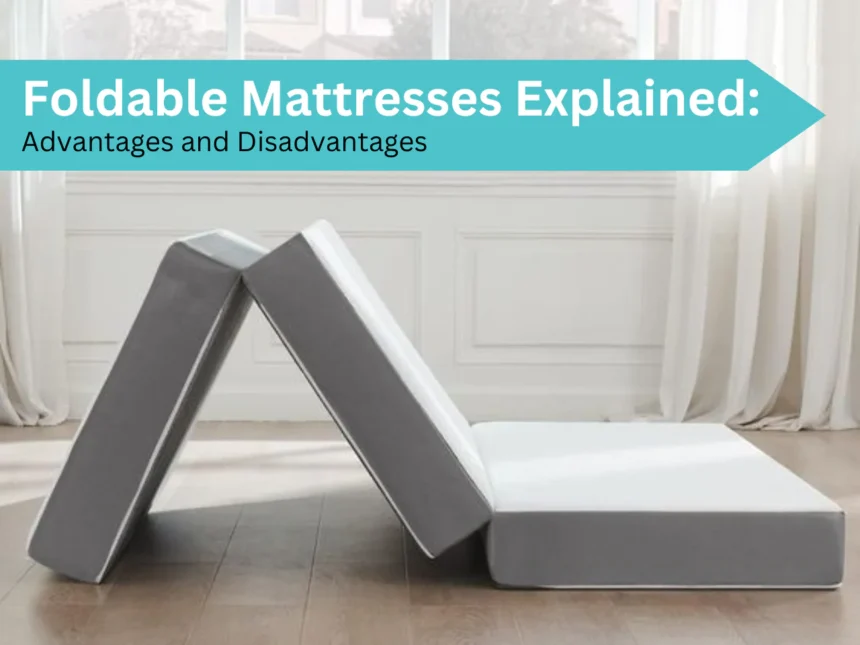
No one will be surprised by a folding mattress anymore. These days, a lot of businesses offer them, and their selection is always expanding. This is only a way to package, transport, and store things; it is not a distinct kind of building. In other words, mattresses that are twisted and those that are not may have identical qualities. However, one producer will package the goods in a roll, while the other will sell them unfurled as is customary. Let’s examine the technology behind this kind of packaging, including its benefits, drawbacks, and restrictions.
The Method for Folding Mattresses
When folding up materials, specialized machinery is used. It is necessary to eliminate extra air from the structure and compress it as much as feasible. Such compression ensures a five to ten times decrease in size in springless variants. However, neither the cover nor the fillers are harmed.
- Spring mattress variants are also twisted during manufacturing. However, there are many prerequisites for this:
springs that are thin and sufficiently flexible to be compressed tightly without breaking the spiral; the lack of thick, rigid filler materials that could crumble under extreme compression (like coconut coir); a frameless model, since a dense metal or plastic frame will deteriorate in the twisting apparatus; - When rolled up, an elastic cover runs the danger of not withstanding the strain and exploding since it is a highly solid, non-stretchy material.
- The mattresses are sealed in a thick layer as soon as they are rolled. In addition to keeping the goods wrapped up, it shields the material from moisture, dust, and filth. The product gradually regains its typical proportions once the film is removed and the inside is filled with air.
- It can no longer be manually rolled up to its initial form after that. It is thus preferable to deliver such mattresses right away to their destination. This is not the ideal option if you purchased sleeping quarters for a summer cottage but had already chosen to use them in the flat. Much more room, time, and effort will be needed for subsequent transportation. In the home where the mattress will be permanently placed, unroll the roll.
The Benefits of Folding Mattresses
- Folding mattresses have advantages and disadvantages. Among their benefits are the following:
small and portable. For spring items in particular, this is accurate. Independent spring block designs often need a large amount of area. It is quite hard to carry the model in a vehicle if you purchase it unfolded. Additionally, most automobiles can accommodate the rolled product. - Nothing can be said about thin springless solutions since they are portable, lightweight, and space-efficient, even when used on public transit. reduced delivery costs. This is true whether the shop or a transportation firm delivers the vacuum-packed mattress. In the second scenario, a twisted solution is preferable since tariffs often rely on weight and dimensions. The consumer saves a lot of money. Considering the following point in particular.
- Moving from floor to floor is simple. It is difficult to ascend stairs, particularly narrow ones, with a typical huge mattress. Fitting the merchandise into the aisles requires careful unfolding and a significant amount of time. The roll version is considerably easier to use; you may use it to enter an elevator, if one exists, and ascend any stairs.
- Simple to store. People who are used to purchasing items ahead of time so they may be kept until the appropriate time would value this chance. A folding mattress’s compact size allows it to be placed on a glazed balcony (but out of direct sunlight), in a spacious closet, in a dressing room, or on the mezzanine for extended periods of time. This won’t be an issue if you bought two or three roll-up versions (for a guest room or the whole family). However, find out how long the manufacturer permits the twisted form to be stored. Usually, it lasts no more than six months. After that, the mattress is either utilized or just unraveled to allow it to take form.
- Manufacturers started rolling up things before selling more often, which benefits budget-conscious consumers. However, there are drawbacks to this technique as well.
Folding Mattresses have Drawbacks
We would like to remind you once again that not all mattresses are rollable. This is a limitation of the technology itself to a certain degree. However, if we look into roll goods’ drawbacks, they are as follows:
- After unpacking, the folding mattress cannot be made compact again. Rarely, this will occur when the materials are soft and the products are very thin, but even in such situations, the process is challenging. In other cases, the mattress cannot be twisted back after it has
- straightened after being opened. The need to keep a close eye on unpacking accuracy. The items exert a lot of strain on the film since they twist while under pressure. A densely compressed mattress has the danger of “shooting” if the coating is cut suddenly. Unpacking should be done away from delicate items. Additionally, take care not to use a knife or scissors to harm the case itself. Slice the package in secure locations.
- It takes time for the desired form to return. Manufacturers typically give this 72 hours. While some models straighten in a single day, it is preferable to wait as the extra time will only be advantageous. After unpacking, it is advised to flip the mattress over many times on various
- Sides while it is resting and absorbing air. A chemical odor that appeared after packaging. All lines—luxury and budget—have this. Twisted models have a stronger chemical odor. This is because mattresses are packaged right away after production and kept in this condition at the manufacturer’s warehouse. As if it were sealed within the building, the odor may vanish after regular storage. Because of this, the product has to be straightened before being vented for a few days. However, this advice is often valid for non-twisting devices.
- The drawbacks of roll models often overlap with the benefits of traditional models or are comparable to their drawbacks. This is not to argue that there are any glaring flaws in this technology that would justify not purchasing it.
Which Fillers Are Used in Folding Mattresses?
The possibilities for filler vary depending on the model. Certainly no delicate components like pressed coconut coir are used in these items. However, they often include:
- Autonomous spring blocks, including ones with a large number of springs per square meter.
- Natural latex: It has a high degree of elasticity and flexibility and maintains its qualities flawlessly even after twisting. Furthermore, even after extended exposure, the material flawlessly regains its form.
- Synthetic latex: Although it is less elastic than natural, it can withstand twisting rather well. This is particularly true for models that use thin coatings of this kind of filler.
- Various foams made from PU foam: Polyurethane foam is also used to make the latex that was previously described. Many fillers are made from polyurethane foam, however the additives that are added determine the qualities of the foam. Most of the time, foams are elastic, soft, and good at regaining their form. And when folding mattresses are let to rest, this is just what they need.
- Ordinary materials are used for casings in these models: These are often polyester-backed mixed jacquard textiles. When folded, they extend enough without losing density or exploding.
Guidelines for Unpacking a Mattress That Has Folded
We have previously discussed them in part, outlining the drawbacks. However, the following clear and easy-to-follow instructions will work for any buyer:
- Clean the floor or any other surface where the mattress will be placed, then use a moist cloth to wipe the mattress packaging clean of dust and grime.
- Take off the film’s top layer. Typically, this kind of packaging serves just to shield the item from dirt.
- Make sure the vacuum packing doesn’t come into contact with the mattress’s surface. When unfolding, do this in a roomy area where nothing will come into contact with the mattress.
- Lay the product down on a level, hard surface after unscrewing it and aligning it as much as you can. Thus, it has to be left for three days.
If at all possible, provide the space excellent airflow. If this isn’t feasible, hold off until the mattress straightens. After that, move it to the balcony or yard to get some fresh air. Whichever option you decide on, be sure to shield the surface from moisture and sunlight. - Vacuum the mattress once it has been straightened and let to air out, then cover it with an appropriate mattress topper. Before utilizing any mattresses, we advise using waterproof mattress protectors. Any product’s lifespan will be greatly increased by doing this.
- The product should be handled the same as any other when it has been unpacked. Keep the mattress away from dampness, only clean it with dry cleaners, and rotate it sometimes. Long-term, consistent surface wear is guaranteed by the flipping manipulation. By doing this, you may prevent the structure from deforming too soon.
Choice Restrictions
There are several orthopedic options and traditional designs without noticeable orthopedics folding mattresses. Adult and kid-sized versions are available, as well as models with and without springs. Additionally, manufacturers provide clients with a range of sizes. These mattresses come in single, one-and-a-half, and double variants. The latter are not often offered in a distorted format.
Seldom are very hefty spring blocks, which are augmented by several additional layers, rolled up. The likelihood of a building being rolled up decreases with its thickness and complexity. This also holds true for non-standard sizes, such King Size bed systems.
Benefits Of Purchasing A Folding Mattress
Once again, we are discussing how mattresses are packaged rather than a distinct class of mattresses. Twisting reduces the items’ size and facilitates transportation. However, the specifications for other attributes that are significant to the consumer are still the same. When purchasing items, consider factors like height, cover quality, orthopedics, degree of stiffness, and filling ratio.
Consider your age, health, and condition while selecting a product. Although the selection of twisted models is not as extensive as it is for conventional items, it is nonetheless available. Examine the manufacturer’s features carefully as they will provide a thorough understanding of the bed’s capabilities, benefits, and any drawbacks.